




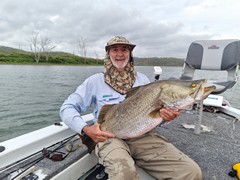


Christmas Island - Pacific Ocean (Blog for Rav)
For the sake of clarity I just want to note that there are two Christmas Islands.
The first is very well know as the Australian detention centre in the Indian Ocean where illegal ‘boat people’ heading mainly from Indonesia to Australia are housed and process when intercepted by our boarder security forces. This is not the Christmas Island this article relates too.
This article is all about Christmas Island, as it is popularly known in fishing circles, in the Pacific Ocean … it’s real name is Kiritimati. It is referred to in the balance of this article as Christmas Island.
Our Christmas Island is a Pacific Ocean raised coral atoll in the northern Line Islands and is the largest coral atoll in the world and is part of the Republic of Kiribati. This Christmas Island is 208 kilometres North of the Equator in the Pacific Ocean and roughly 3457 kilometres North East of Nadi Nadi in Fiji and 2152 kilometres South of Honolulu USA. It has a population of less than 6,000 people. It is a very traditional island with a dominant religious background and a large proportion of traditional housing for its mainly Gilbertise speaking population.
DISCLAIMER
This article is not based entirely on information I have gathered myself as I have only fished Christmas Island for a total of 6 days. Before heading over there however I did research every thing I could find on Christmas Island and the fishing there and whilst I was there I had the benefit of fantastic feed back from my 13 travelling companions (some of which may have been exaggerated as is often the case with fisher folk) and of course I spent a lot of time talking to our guides and picking their brains for as much information as I could.
BACKGROUND
‘Christmas Island’ is part of the Line Group of Islands all of which are part of Kiribati which is officially the Republic of Kiribati an island nation in the central Pacific Ocean that became independent from the United Kingdom in 1979. Along with 32 other atolls, reef islands and just one raised coral island Christmas Island is part of this independent island nation that spans some 3.5 million square kilometres and straddles the equator above Fiji and south of Honolulu. The national capital, where more than half the nations population of some 100,000 people live, is on Tarawa Atoll, some 1,000 kilometres west of Christmas Island.
The Republic of Kiribati is a member of the Commonwealth of Nations the IMF and the World Bank and became a full member of the United Nations in 1999.
The economy of the nation is largely based on:
- Interest earned from the Sovereign Wealth Fund that was set up in 1956 to ‘bank’ earnings from mining large deposits of phosphate up until the late 70’s when the deposits were basically exhausted.
- Export of fish, copra and farmed seaweed.
- Licences to fish it’s national waters
- International development assistance grants to which Australia is a substantial contributor.
- Tourism which is also emerging as an important source of income. An example of that is that Christmas Island now has 5 fishing lodges, similar to Captain Cook Hotel that hosted our trip, and all of those lodges are working hard to achieve high occupancy rates for much of the year.
- For Christmas Island there is also a small industry of evaporative salt farming with its key customer being Japan.
GETTING THERE
Our group planned to assemble at Sydney airport 3 hours before the scheduled departure time and as circumstances unfolded I arrived a little earlier than that. The rest of the group arrived close enough to the appointed time.
We flew Fiji Air and I have to say that it was pretty good indeed. The cabin staff were fantastic, the plane food was plane food but much better than some I have experienced. Free alcohol was served so that was a bonus to most of our team (we regarded it as strictly for medical purposes … you know the pressures of flying) and of course at least one of our team obviously felt the pressure more than the others and consumed more consolation than the others. Then of course the grounds staff who made sure that our departures and check ins were efficient and easy to work with. The aircraft for the first 3 flights were Boeing 737 and the seating was pretty tight but the aircraft for our trip home from Fiji was an Airbus A330-300 which was only 6 months old and was absolutely fantastic.
When we arrived at Christmas Island we were greeted by the local police, all decked out in the blue uniforms and either polished shoes or bare feet, carrying 303 rifles probably from WWII to a relatively impressive marching display and presentations of arms. We took that in our stride and were surprised when we found out that it was not a welcome to us but rather a welcome of the Chief Justice who arrived on the same plane with his entourage … anyway it was all good joss.

|  |
| Our honour guard | Typical transport for us on the Island |
Outside the arrival gate we were greeted by three trucks and drivers. The luggage was quickly loaded into one of the trucks and our group in the back of the remaining two trucks. Those trucks were two of the typical transport vehicles we would use throughout the week to take us to the harbour at London where we would catch the skiffs or to the lagoons for shore bases angling. We were greeted at the Captain Cook Hotel Resort by friendly staff members and light refreshments. It didn’t take long for us to be allocated our rooms so we headed off to settle in and get ready for our first days of flats fishing starting just two hours later.
I think it is worth a note here to say that before heading off on this trip I was told to expect that things may not happen all that efficiently as I expected and that timing was not a focus for our hosts. I did not see that at all and found the people I dealt with to be efficient and always punctual. For example if our guides said they would pick us up at 6:30am they did and the gear was loaded quickly and efficiently. The same applied for our meals and other deadlines.
Our rooms were also serviced each day which I had not expected and a nifty touch was the intricately folded bath towels on the end of the bed when we got home each day… there was a real level of caring and seeking to do their best from everybody that looked after us.
 |
 |
| Towels nicely folded each day was a nice touch | Keep your door closed otherwise you may have unwelcome guests |
There is only flight from Fiji to Kiritimati each week and that departs from Fiji at 2359 each Tuesday, crosses the international date line at the equator and consequently arrives on the same day. Arrival is at 0640 am. That flight continues to Honolulu from Kiritimati and return later the same day departing Kiritimati to return to Fiji where again you pass the international date line this time loosing a day and arriving at Nadi Nadi at 1935pm.
The late arrival at Nadi Nadi on the return flight means that because of the curfew at Sydney you have to overnight in Nadi Nadi and return home the following day.
Our overnight stay was at the Raffles Gateway Hotel and that was fantastic … particularly the hot shower. Since coming home I have wondered if for the return it may have been better to fly to Honolulu departing Kiritimati on the 0740 flight to Honolulu and them making a connection from Honolulu to Sydney on the same day. That would save an overnight stay in Fiji. I’ll investigate that for my next trip.
OUR DIGS
I am not sure if the hotel was built before or after the nuclear tests that were conducted by the United Kingdom in the late 1950s, and by the United States in 1962 but except for the central courtyard many of the buildings showed significant signs of decay and neglected maintenance and in fact a few had been closed up. The bungalows that we were assigned to however turned out to be fine for a fishing holiday but I must say that I missed having a hot water shower. At least 2 of the 7 bungalows did have hot water and I will certainly be making a case to my trip organiser that they should be assigned on a age seniority basis next time.
Two special evening meals were served in the courtyard area during our stay and in both cases I think that was because the High Commissioner was eating at the same time as us. For both these meals the food was fantastic with the real highlight being a roast full pig on the second last night. The side dishes for that meal included dolphin fish and cray fish caught that day. For each of the two meals that we enjoyed in the courtyard there was some local entertainment. On the first night a girl of probably 14 years of age did a traditional Polynesian type dance and a boy of probably 12 years of age did a more masculine but equally impressive Micronesian type dance which was probably some sort of coming of age production. On the second evening meal night in the courtyard one of the hotel staff did another traditional dance and that was fantastic also. I must say that I haven’t really watched traditional dances of this type so closely and in all case could not believe the amount of intricate foot work that was involved. After the first night I approached the hostess and thanked her for the presentation and complemented her on the fact that the young people were obviously very proud of what they were doing and that we were profoundly impressed that they were such good ambassador for their culture. Interestingly the hostess knew and called me by my name for the rest of our visit.
 |
 |
| This was the biggest suckling pig I have ever seen | Seating in the courtyard area |
Our breakfasts and the rest of our evening meals were taken in the dining room. For the breakfasts there was a simple but well optioned breakfast menu which provided good choices for us all. The evening meals were served buffet style and generally were a combination of a couple of local type dishes and one or two western type dishes. We had dessert on three nights, twice ice cream (yummy) and unfortunately just the once a very nice vanilla cake that pampered my sweet tooth.
As arranged we prepared our own lunches from makings available at a separate table at breakfast. Some of the guys relished that but for me as I am not a big bread eater, at the best of times, and the bread was very thick cut and quite sweet it did not tickle my fancy. In any case I didn’t starve and was able to organise to have two slices of bread toasted on most days which I buttered and jammed for lunch. The fillings for those that wanted sandwiches was basically lettuce, processed cheese slices, devon and processed ham each day and slices of tomato on all but 2 days. One of our team obviously had forward advice about lunches and brought along flat bread for his own lunches. That was a good idea and next time I’ll take along Sao biscuits and vegemite as additional lunch options.
Most of us took along our own snacks and that included muesli bars, lollies and even liquorice allsorts.
The power points at the hotel were all US 110V and the currency for the island is Australian dollars.
GUIDING
Our guides were assigned on a 2:1 basis and that turned out to be more than adequate. The guides were very accommodating as along as you wanted to catch bonefish. They are very proud of the fact that Christmas Island is portrayed as the bonefish capital of the world and find it hard to understand that you want to catch anything else. As the days progressed we did get the message through that we were keen to catch other species and so we did get more options to target the difficult to catch trigger fish and quite a few smallish trevally up to around a 50cm long. Many of our anglers wanted to catch big trevally and whilst we did see some small blue, golden and GT trevally when bone fishing only one group on one occasion did specifically target big GT’s. On that occasion one 50-60 pounder was hooked but unfortunately in close quarters it busted off.
On one day we accessed the closer lagoons directly from the truck. That was fine and gave us access to a couple of lagoons that are difficult to access from the water. On all the other days we travelled by truck to London at the west end of the island and boarded ‘skiffs’ there to head out to the various lagoons. On those days truck and skiff travel took around 1.5 hours before we actually wet a line.
 |
 |
| Typical Christmas Island skiff | Views like this every where you turned |
The local population mostly speak the local Oceanic language of Gilbertese and whilst English is also an official language of the Republic of Kiribati it is not used very much away from the capital of Tarawa. The Guides do however all speak enough English to ensure that they mostly understand English but in some cases they understand more than they can share with English speaking visitors to the island.
The guides are very professional and well trained and interestingly have their own Christmas Island training program for guides. Entry is very restricted and only those that learn all the required skills actually get a position as a guide. Our group of 14 had seven guides as well as one trainee guide working with one of the head guides as a mentor. I understand that all of the guides are required to learn and practice fly fishing and it would be hard not to be impressed with their fantastic understating of the tides and how they affect the various lagoons. I was in awe at how they always arrived at the shallow crossings into the various parts of the flats with just enough water under the keel. On an incoming tide in many cases they would not get through to the next lagoon ten minutes earlier and on the outgoing tides they and you of course would be stranded if you were leaving half an hour later … great seamanship.
The fishing program is written up on a board in the dining room each night for the next day so there is no misunderstanding about who your group members are, which truck you need to catch, which lagoon you will visit and importantly what your target species will be.
On my next trip to Christmas Island I will be making my tour organiser aware that I want equal time fishing for pelagics and bonefish and asking that be communicated to the guides before heading off.
FISHING AND GEAR SET UP
For me there are basically 3 basic levels of fishing to prepare for.
BONEFISH AND BY CATCHES OF GOAT FISH, AND SMALL PELAGICS
 |
 |
| Best bonefish for the trip – 8lb according to our guide | As the tide comes in over dry flats like this big bones venture from the depths |
As you are flying into Christmas Island hopefully you will get a bird’s eye view of the largest coral atoll in the world. Your first view of the flats is an area of hundreds of patches of bright azure water interspersed with equally large areas of white to golden sand flats with plenty of patched of darker brown water. The collage of these waters changes with the tide rises and falls creating a continually changing and complex environment.
As the tide drops and the flats progressively shallow out bonefish progressively become more nervous and harder to catch and move off the flats retreating to deeper water. During this phase you’ll need accurate casts so as not to spook fish. Fishing for bonefish is at its best as the tide rises as the fish progressively move back onto the flats to forage for food. The small fish move in first and as the water gets deeper the bigger fish follow. During this part of the cycle they are hungry and sometimes they are almost easy to catch. You’ll still need accurate casts and to remember that the biggest fish didn’t get big by being stupid. If you want to target bigger than average fish the tactic I was taught was to fish the margins of the flats on the incoming tide searching the deeper water for a glimpse of a fish. Even then you will need to sight the fish well out and to put in a good cast. If the fish is moving toward you put the cast in along the line you expect the sighted fish to track with the fly landing cleanly 4 or so metres ahead of the fish. Then when the fish closes the gap to within two metres start long slow strips. If the fish is moving at an angle to you again you need to cast well in front of the fish and then commence your long slow strips so that the fly will come into the fish’s vision without spooking it. These processes came up trumps for me on several occasions.
Realities imparted to me by my guides:
- Small fish like faster moving flies but big fish like slow uniform retrieves.
- The deeper the water the heavier the fly you need and the shallower the water the converse applies.
- The same applies to hook size with #6 bead chain head flies being the go in ankle deep and shallow water and #4 heavier dumbbell eye type flies coming into their own as the water deepens or you move into the margin.
- Colour of the fly is important also and a good rule of thumb is to try to match the colour of the fly with the colour of the sand bottom itself or the intermittent features on some of the sand bottoms. So the dominant colours of your bonefish flies should be orange, pale pink, tan and white.
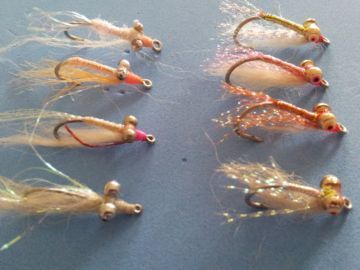
Choice of fly pattern is a ‘lay down misere’ with the Christmas Island Special being the guides and it seems the bon fish’s preferred fly. I took along heaps of others and they were all rejected by the guides … others in the group had a similar experience.
 |
 |
| Caught on the first day this was the biggest of my 3 triggers and the best Trigger for the trip | This was described a a ‘Lady Fish’ but I would call it a Herring. |
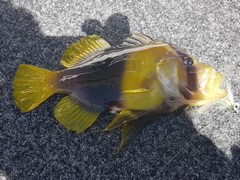
Perhaps the most prevalent fish on the flats is the milk fish. To the untrained eye it’s very difficult to distinguish these from bonefish as they mover across the flats. As you get a bit more experienced you notice that whilst the bonefish swim head down and close to the bottom with their heads generally down watching for food and swimming generally in relatively straight direction milk fish swim much higher in the water column and generally waving from side to side along a haphazard path. The guides explained that except for the very occasional ‘lady fish’ milk fish are seldom caught on fly. Having accepted that this 18” lady fish didn’t know that it was not supposed to take my Christmas Island Special.
Any rod from say #6 to #9 will be fine for bonefish but the guides regard #8 weight 9 foot fly rods as being the standard. You will definitely be able to catch and land standard bonefish on a #6 weight rod but if you hook a six pounder plus you may come unstuck. Heavier rods than #8 will work also but as the heavier line will by definition present less delicately than a #8 weight line you will spook heaps more fish. The only line you will need on the flats is a floating tropical rated line and because you’re often fishing only intermediate distances a line that presents half a weight up is a good option. I had 4 or 5 fish take me to the backing and my largest fish which was around 8lb according to my guide and 70cm long took around 75 metres on the first blistering run and then a little less than that on the second run. Christmas Island bonefish do get up to around #10lb so I can imaging a big horse like that could take you well beyond a 100 metres of backing and I suggest that at least 200 metres of backing is appropriate. The other thing to focus on is to so make sure that you have a good line to backing connection. Leaders of #14 lb are the go and if they are tapered or stepped down leaders that will help turn over the heavier flies. I fished a leader of straight Sunline FC Rock in 14lb for the first half of the trip and to improve the turnover of my fly swapped to a leader of 3 feet of 20lb followed by a tippet of 6 feet of 14lb Sunline FC Rock and on the later days and that was certainly better.
The set up I have is a 7’ 9” Redington Predator fly rod matched with a Hardy HDS 10000 fly reel. This reel is an overkill for bone fish but I have a number of these reels that I use for all my salt water fly fishing from #8 weight through to #10 weight … so I always have a back up reel. These reels have 300 metres plus of 80lb backing and a double bimini twist connection for the fly line. The line I chose was a Scientific Anglers Mastery Grand Slam WF-8-F. Adam form the Complete Angler recommended this line and brought it along with him to Christmas Island for me … a great recommendation Adam thanks for the line.
TRIGGER FISH
 |
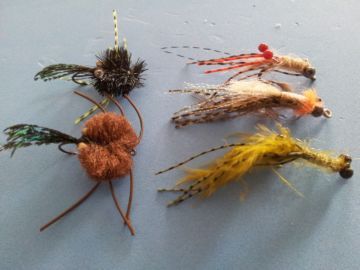 |
| Captured on the first day the was the biggest Trigger for the trip | Tied on sturdy hooks these are ideal ambush flies for Triggers |
In the strangest way these fish were a wonderful diversion to bonefish on the flats. I am not saying that I got tied of catching bone fish but I did find the antics of the trigger fish intriguing and unpredictable and for them to be a very formidable target species.
Putting that into perspective I think that the group of 14 fly fishers would have caught and released something like 2,000 bone fish over the 6 fishing days and only something like 15 to 20 trigger fish in the same period.
Several of our group including myself caught trigger fish using the bonefish fly we had on the bonefish set up we were using at the time. For me on two occasions that was an orange size #6 Christmas Island Special. The third fish took a shrimp pattern that a mate gave me prior to the trip. For the guys that specifically target trigger fish, I am pretty sure they stayed with their bonefish set up but swapped over to a trigger fish oriented fly. It seems that black or brown crab fly tied on a very solid hook (looked like size #6 to me) was the preferred fly.
Undoubtedly the best tactic to catch a bonefish is to target them when their head is down feeding on the bottom often with their big paddle tail out of the water. Work out the direction they are feeding and put the fly a metre or so in front of them on that line and wait. If you keep in touch with the fly you can feel the fish foraging around your fly. If the line firms up that is probably the fish mouthing your fly … don’t strike straight away. It’s hard but count 5 seconds first and then do a slow strip strike. If the fish is on you will know it if its not you then have two choices. Let the fly settle if the fish is still feeding or if you think the fish has seen you your fly and is not spooked then do a very slow draw with the fly. You will know if you have spooked a bonefish as they high tail it away from you as fast as possible.
BIG GT’s AND OTHER TREVALLY
 |
 |
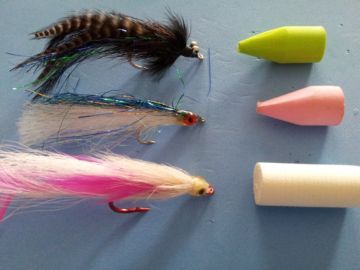
| A couple of GT fly options | Hardy HDS 10000 reels set up for GT’s |
When fishing the flats most of our group caught some small trevally as by catches. There fish were typically small GT’s and blue trevally and the occasional golden to around 50cm. Two additional by catches were goat fish up to around 30cm long and tropical snapper to around the same size, perhaps a bit larger. Most of these fish were opportunist feeders that took our bonefish flies.
When setting up for my Christmas Island trip I had in mind targeting GT’s up to 30lb as key element to my trip and pretty well most of the time either had the guide carry my #10 weight rod or carried it myself. The opportunities to use that rod for GT’s to 30lb unfortunately turned out to be virtually non existent on that trip.
I did find a school of GT’s to around 50cm long one day and swap over to that rod. I had it rigged with a 2/0 pink and white deceiver behind an articulated popper head and on those fish it worked a treat and the fish were all over it allowing me to catch and release 10 or so fish in a short space of time. I can only imagine how satisfying it would have been if these fish had been 6 or 8 time bigger On another occasion like many other members of our group I did see a big GT of 40lb plus and whilst I new that my set up was ‘under gunned’ I still had a go at it … to no avail.
Nobody in our group got a trevally above 5lb for the trip which was disappointing … such is fishing.
I am confident that the gear I set up for GT’s to 30lb would have been up to the mark and consisted of an 8’ 3” Redington Predator fly rod balanced with a Hardy HDS 10000 fly reel. This reels has 300 metres plus of 80lb backing which is finished with a double bimini twist connection for the fly line. I had two spools set up for GT’s. The first carries a Scientific Anglers Sharkwave Saltwater Titan WF-10-F fly line. That line has a 70lb core and I have finished it off with quad wrapped line loop to accommodate the loop to loop connection with the double bimini twist loop knot in the backing and a quad wrapped line loop that is reinforced up to the first wrap with monofilament braid. I am very confident in this set up as I have been using it for about a year chasing big fish around Gladstone in Queensland.
Big GT’S above 30lb are definitely the domain of #12 weight plus rods and I would suggest that a similar set up to my #10 weight except for line and rod weight would be the way to go.
Having said that I have to say that whilst I know I would have been under gunned I would definitely have a go at GT’s of whatever size with my #10 weight set up … what’s the worst that could happen.
I can’t wait till my next ‘bucket list trip’ comes around … hope you found this helpful.
Regards, Chatto