






Fingermark
One of the most popular target species of fish, not only in Australia but throughout the world are the Lutjanids and we are lucky enough to have two of the family, Fingermark (L.johnii) and Mangrove Jack (L.argentimaculatus), endemic to our coastal and estuary waters in Central Queensland.
Whilst very closely related they are still quite different in many ways with some of the obvious differences being:
-
- Fingermark are gregarious fish and whilst you will find them schooled up feeding their cousins Mangrove Jack are more solitary and prefer to hunt alone.
- Fingermark prefer to feed in deeper water with a preference of a gravelly bottom whereas Mangrove prefer to get into the mangroves as the tide rises and to hunt for tucker there.
- Fingermark grow to a larger size than Mangrove Jack.
 |
 |
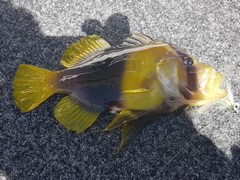
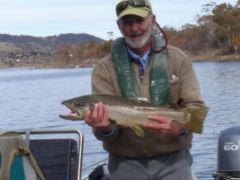
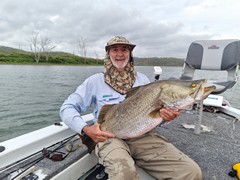
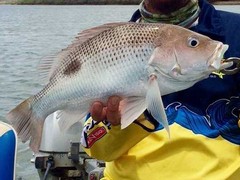
| Boyne River Fingermark | A Narrows Fingermark |
Even though Fingermark can be found schooled up and feeding in waters beyond our estuary waters I have limited the scope of this article to fishing for Fingermark in estuary and inshore tidal fisheries in central Queensland.
Fingermark (L.johnii) are very solid fish that have powerful teeth. They have big powerful tails and are very much the close combat specialists. The colour of Fingermark are basically silver and often with shades of red under the chin or on their face.
They are found all year round throughout the northern half of Australia and are a highly sought-after target species on both fly and lure.
In the colder months Fingermark reduce their metabolic rate and reduce their food intake but of course you can still target them in some of the locations described below particularly those where their feeding intake provides more energy than the effort they have to use up. Then as the water starts to warm up in late spring their metabolic rate increases and their food intake increases.
Both juvenile and maturing fish are essentially estuary fish but bigger fish move beyond our estuary and inshore tidal fisheries.
An average size 40 cm Fingermark is a powerhouse but they are pretty clean fighters even though they fight well above their size.
Fingermark are both scroungers and predators in that on the one hand they will foraging around the gravel bottom or in and around structure for tucker yet on the other hand they will take advantage of structure and wait for food to come to them.
HABITATS
Our estuary and coastal Fingermark frequent a wide range of natural habitats including deeper pockets of water in all sorts of habitats particularly near mangrove lined shore lines in both open estuary waters such as harbor and bay shorelines, rivers and creeks, tidal run offs from gutters, rivers and creeks, snags and rock bars.
Other locations that Fingermark frequent are man-made structure such as bridge, jetty, mooring structure and rock walls.
For any of these types of habitats that get uncomfortably shallow for Fingermark at lower tides keep in mind that they will be more inclined to hold fish if there is deeper water close by that they can retreat to.
Those deeper retreats are a main habitats for Fingermark. Even better if those deeper areas are over gravelly areas , have wonky holes, hold their own structure such as rock bars or sunken timber that stays covered on low tide … a good way to locate those areas is to do a lot of scouting about on low tide and to lock appropriate marks in on your GPS/sounder.
Around Gladstone popular areas to target Fingermark are deeper pockets of water close to structure of our coastal rivers including the Calliope River, South Trees Inlet and the Boyne River and the mangrove lined back waters of the harbor and structure in local estuary bays like Colosseum and 7 mile and moving a little further away the Narrows and Turkey Beach.
FOOD SOURCES
Fingermark chase the same sort of food items as Mangrove Jack, Grunter and Flathead including; prawns and shrimp, small fish, crabs, mollusks such as rock oysters and worms so it’s not surprising that fly and lure representations of those naturals are a good choice when targeting Fingermark. That is not the end of the story for mangrove jack they are very territorial and will willingly take other non-natural looking offerings that ‘inadvertently’ draw their attention.
As it turns out Fingermark are cathemeral feeders which means, that because their eyes have evolved to allow them to hunt in times of low light, that when they feed is determined by other factors other than night or day. Those factors are what we call trigger events.
Fingermark understand those trigger event ever so well as it’s entrenched in their DNA.
For us, the more of those triggers that we can understand and line up the better our fishing outcomes will be. When less triggers line up it’s reasonable to expect that Fingermark don’t eat so well and when there are no triggers the Fingermark just don’t feed and may go hungry. Sure, they may scrounge up something to eat but without the triggers being present and creating what Fingermark see as bite windows Fingermark won’t congregate and our chances of finding numbers of feeding fish in predictable places gets harder.
As anglers what we have to do to get the most out of our fishing time is to recognize what the triggers for bite windows are and what causes the triggers to be in different places at different times so that we can take advantage of the accumulation of those triggers, just as the Fingermark do.
I have set out below triggers which can have a profound influence on the occurrence of bite windows and consequently the success or failure of a barra fishing outing.
As I understand it the three main trigger event that instigate bite windows for Fingermark are tides, barometric pressure and low light. I have described their influences below:
Generally, Fingermark are most active on the last of the rising tide and the first of the falling tide.
As you work through this post you will realize that a good strategy, particularly if you have a high tide around dawn or dusk, is to fish sessions that include the last two hours of the rising tide and the first two hours of the falling tide.
FEEDING CYCLE
-
-
-
- As the tide starts to rise small fish, shrimp and prawns move toward and into the mangroves and other structure where they can feed and feel relatively safe.In response to that Fingermark follow the tide from their deeper holding water to sandy and muddy bays and closer to mangroves, in the early part of rising tides, to pick of small fish and shrimp as they run that gauntlet to get into the cover of the mangrove roots to feed.
- In the latter part of the rising tide as the tide inundates deeper into the mangroves and the small fish and shrimp follow the flow and reach the relative safety of the roots of the mangroves and behind the mangroves fingermark continue scrounging in those sandy and muddy bays and closer to mangroves and mop up stragglers.
- As the tide turns, reducing the comfort depth for the small fish, shrimp and prawns, they run the gauntlet again, this time, to get back to deeper water. Fingermark, do the same and, retreat from the sand and mud flats and from close to mangroves areas that they have been scrounging in to those holding waters where they were scrounging as the tide started to rise.
- As the small fish and shrimp find what cover they can in weed and other structure in the deeper holding water fingermark either lay up after their feeding cycle or continue to scrounge up what they can.
-
-
THE GEAR
FLY FISHING
You can certainly get away with an #8 weight outfit for most Fingermark but if your fishing in places where bigger Fingermark are likely or there is a chance that as a by-catch you may hook a bigger species such as Big Trevally, Big Queenfish, Barramundi or Threadfin Salmon. Given that by-catch posability I always fish with a #10 weight outfit. That is nearly always loaded with 30lb braid and a clear intermediate line with a loop knot at the business end. That is connected to a loop knot on my leader which is a rod length of straight #30lb Maxima Ultragreen. At the business end of the leader I fish with a #3 Mustard Fastach clip which makes it easy to swap flies.
I suggest that any time your fishing into structure that you use flies with structure guards so tat you can fish slower and allow your fly to get to where the fish are holding.
I do like to vary my retrieves but more often than not a simple hand pulls of different lengths, with pauses of different lengths, with a hang toward the end of the retrieve does the job. A lot of takes come as the fly settles on the pause or the hang and then the only problem you have is to get the fish out to clear water and into the net … often easier said than done.
My choice of fly selection is well covered in My big fish fly box – temperate & tropical destinations
DARK SIDE
Both spin and overhead outfits have their advantages and disadvantages but more often than not I fish with a 6-7 foot spin rod with a medium to soft tip and plenty of grunt down low balanced to a 4000 to 5000 series spinning reel or a 150 to 200 series overhead reel. As I noted when talking about the choice of fly gear:
You can certainly get away with lighter outfits for most Fingermark but if your fishing in places where bigger Fingermark are likley or there is a chance that as a by-catch you may hook a bigger species such as Big Trevally, Big Queenfish, Barramundi or Threadfin Salmon.
My preference is spin gear and that has 30braid backing, 1.25 times the rod length of 20 fluorocarbon lead connected to the braid with a an FG knot and a #3 to #4 Mustard Fastach clip which makes it easy to swap baits.
I do like to vary my retrieves but more often than not a simple slow to fast rolls with pauses or twitches thrown in witha hang toward the end of the retrieve works well. A lot of takes come as the bait settles on the pause or the hang and then the only problem you have is to get the fish out to clear water and into the net … often easier said than done.
The outfits that I prefer for this type of fishing are 3-6kg overhead outfits with 20lb braid backing and a rod length of 20lb Sunline FC Rock connected to the backing with an FG knot. The reason for the choice of the overhead outfits as opposed to spin outfits is twofold:
-
-
-
- For the species and fisheries concerned I find it easier to give line with the press of the thumb on an overhead real and then being back in contact with the line with just a touch of the handle rather than the manipulating the bail arm on a spin reel.
- More often than not a large part of success in these fisheries relates to accurate casting in to tight positions around an behind mangroves and other structure and in being able to flick a lure under overhanging structure. With practice overhead outfits are much better at this than spin outfits.
-
-
I generally carry three classes of lures:
-
-
-
- I enjoy fishing with paddle tail, grub tail and swimbait soft plastics so it’s not surprising that the ones I make and proprietary TPE and plastersol soft plastics more often than not are my goto option when targeting these iconic species. I rig them on jig heads of different weights and always try to get away with the lightest weight possible that allows me to effectively fish the soft plastic at the desired depth and in the preferred way. A few of those soft plastics also lend themselves to being set up weedless so they can be cast into structure.
- Hard body lures area great option too but, as the better ones are fairly expensive and pretty easy to snag up and loose I generally only revert to them if I’m fishing over areas that are not too snag endowed.
- I have found that vibes are a great bait for all scroungers so I always have a box of vibes in my kit. Because getting snagged is a regular occurrence when fishing for any of scrounger fish the vibes I use are generally on the inexpensive side rather than the big brand heavily promoted vibes. Given that tidal runs can be very fast and sometimes make it difficult to get the vibe to where it can be jumped along the bottom I have no hesitation in adding a snake lock weighted snap lock at the end of my leader or incorporating a small ball sinker in the loop knot that connects to the leader to the vibe. This configuration allows me to get the vibes down to where I need to fish them. The offset is of course the snake lock weight or the ball sinker may spook some fish but at the end of the day if without the split shot you cant consistently get vibe down to where the fish are feeding the occasional spooking of a fish is a good concession.
-
-
ZMan soft plastics set up weedless on TT weighted shank twistlock beast hooks in various weights are very effective but I have learned that they can be an expensive choice. As it turns out the “ElaZtech” Zman proprietary TPE material melts and deforms other Zman soft plastics and traditional plastisol based soft plastics and must be stored away from all plastisol soft plastics in a non-PVC based container or their original sealed packaging. That sounds easy but the smallest of storage mistakes can turn out to be an expensive problem.
You’ll find plenty of specific lure, soft plastic and vibe options at “Coastal & estuary lures”.
STEALTH
Keep in mind that Fingermark are easily spooked so you have to be stealthy in your movements and casts.
-
-
- So when you approach an area you going to fish do it slowly and if available quietly under the power of your electric motor and take advantage of any cover that’s available. Don’t cast a long shadow over or motor over over the water your going to fish. Longer casts are important and cast to the side of any fish your targeting.
- If your using an anchor deploy and retrieve slowly so that there is no bumps or chain noises that will spoke fish.
-