






Barramundi
Over time I have come to understand that there are two distinct classes of Barramundi in Lake Awoonga and other similar freshwater impoundments … “residents” and “travelers”.
Residents
Barra are released into Lake Awoonga generally at a range of sizes from fingerlings to grown on fish of around 30cm in length.
With the abundance of food sources which includes bony bream from just a few centimeters in length to hand size fish, mullet of a range of sizes, other small fish including snub nose gar fish, barred grunter and catfish and red claw and shrimp there is an abundance of food and consequently the juvenile and teenage barra grow at about twice the rate they would have in the wild.
So, by the end of the first year even the fingerlings have grown up to around 30cm in length and over the second year they go close to doubling their weigh. Their growth rate declines as they grow but is still impressive and for above 70cm growing something like 10cm a year.
The stocking process is well organized and the fingerlings and slightly grown out barra are widely dispersed in weedy locations around the lake so as to avoid cormorants and bigger barra being able to gorge themselves on the new arrivals. Unfortunately catfish are prolific in the lake and also wildly dispersed so they take a toll on particularly fingerlings.
They start of by being very gregarious and school up and take up residence with their cohort in those appropriate weedy nursery areas. Those areas are made up of extensive healthy thick weed beds that are also the habitat of the food sources that barra thrive on. The weed beds do wax an wain in health in response to changes in water depth, seasonal changes in wind direction and water temperature but in general the change is creeping rather than overnight and that leads to the smaller barra being resident of one general area in their formative years.
Progressively as they mature and grow most barra become more confident and individuals and small cohorts generally above 80cm in length, leave their nursery area and move further and further away and progressively become travelers rather than residents. It’s interesting that a very small number of bigger barra, for one reason or another, never leave these residential areas.
Working out where to catch resident barra is definitely easier than finding travelers and it’s a matter of applying the information described later in this post “DEALING WITH WHERE …” to determine areas where there are long term, albeit creeping weed beds as described above.
Travelers
These are bigger confident fish that have matured and have moved out of the nursery areas into a lifestyle of spending most of their time in deeper water.
In that part of this post “DEALING WITH WHERE …” I have identified some of the triggers that motivate traveling barra to move into areas where bait fish are or are likely to be at a particular time so they can either snack or aggressively feed on bait fish.
So, whilst they spend most of their time relatively spread out in those deeper areas, which I have learned to refer to as their “lounge rooms“, they rely on urges entrenched in their DNA, and triggered in their environment, to work out where the “kitchen” is and consequently where their feeding needs can be best satisfied.
Working out triggers that motivate those urges that barra are responding to makes a mammoth difference in your chances of hooking barra in the 90cm, magic meter and bigger ranges. Those triggers are described in detail below particularly under the heading later in the post “DEALING WITH WHERE …” but for the travelers you have to take a macro approach to the more open waters and accessible feeding areas.
SO, THE PROCESS BEGINS.
 |
There is an old adage, “moon rise at night fish at night, moon rise at day fish at day”. I wish it was just that easy for barramundi fishing but of course it is not. My strong preference is to have the moon above but “moon above” is only part of the answer when it comes to answering the question … when and where is the best time to catch barramundi?
So, where do we go from here in answering the question.
The first thing I want to put on the table is that not all fish species are alike and I think it’s important to recognize that, and to take into account, the individual feeding habits of each fish species. If you want to catch more barramundi that comes down to understanding what triggers barramundi when and where to feed.
As it turns out Barramundi are cathemeral feeders which means, that because their eyes have evolved to allow them to hunt in the dark and at times of low light, that, when they feed, is determined by other factors other than night or day. Those factors are what we call trigger events.
Barramundi understand those trigger event ever so well as it’s entrenched in their DNA.
For us the more of those triggers that we can understand and line up the better our fishing outcomes will be. When less triggers line up it’s reasonable to expect that barra don’t eat so well and when there are no trigger events, the barra just don’t feed and may go hungry. Sure they may scrounge up something to eat but without the triggers being present and creating what barra see as bite windows barra won’t congregate and our chances of finding groups of feeding fish schooled up together gets harder.
As anglers what we have to do to get the most out of our fishing time is to recognize what the triggers for bite windows are and what causes the triggers to be in different places at different times so that we can take advantage of the accumulation of those triggers, just as the barra do.
As I spend more time barra fishing I learn about more about the events that trigger bite windows for Barra. Taking trigger events into account can have a profound influence on the occurrence of bite windows and consequently the success or failure of a barra fishing outing. I have set out below triggers as I currently understand them.
I have broken those triggers down into two distinct groups. The first are those triggers that I believe it’s best to take into account when DEALING WITH THE WHEN … … and the second is more about DEALING WITH THE WHERE … at the time your fishing.
Understanding where the trigger events fit in is obvious for some of those triggers but overall understanding the cycle of the moon will help so I have set that out below.
DEALING WITH THE WHEN … PLANNING A BARRA OUTING
For me these 5 elements are the factors should be taken into account when your working out the best time to go barra fishing in a particular fresh water impoundment.
- MOON ABOVE
- SOLUNAR EVENTS
- TIDES AT THE CLOSEST SALT WATER
- TIME OF DAY
- PRE-OUTING WINDS
MOON ABOVE
The moon is above from the time the moon rises until the time it sets and from my experience “moon above” is a general bite window and a time when Barra are more inclined to be active than when the moon is not above.
There is plenty of both anecdotal and scientific evidence to support the understanding that having the moon above when fishing is an advantage. Solunar charts are just one of those bricks of evidence. They reflect the moon above period with one hour minor bit periods at both moon rise and at least one of the major bite windows is generally when the moon is is its zenith (directly above) with the other being roughly 12 hours later when the moon is below your feet. The major bite windows are around two hours each.
Solunar charts which are based on the influence of the sun and the moon on all living things are a place that some fishos turn to answer the question, and they will help, but just like the “moon above” approach above I don’t think solunar charts in them self answer the question in full.
SOLUNAR EVENTS
Digging a little deeper, as well as Solunar theory there is plenty of both scientific and anecdotal evidence to support a conclusion that when the moon is above that a number of events occur that trigger increased feeding activity by Barra.
Lunar cycle related trigger events, can be very short or can prevail for longer periods and it seems that is due to other non moon related trigger events such as wind and weather.
Several of the trigger events are specific parts of the lunar cycle particularly moon rise and the moon sets and when the moon is at it’s zeneth.
Tide change trigger events are created by the gravitational influence on the Earth by the the Moon and the Sun.
Salt water barra are very responsive to tide changes and on both high and low tides they move into structure to feed and between tides they fall back into deeper holding water. Whilst Awoonga and other lakes and impoundments don’t exhibit the same sort of tidal movements that occur in salt water fisheries evolution has left barramundi with an understanding of the effect and responses entrenched in their DNA that are similar to fresh water barra.
So, even if the tidal movement in an impoundment is only a couple of centimeters along the length of impoundment that is enough of a trigger for barra to move into shallower structure to feed around both the top of the high tide and bottom of the low tide.
As the tides get bigger around the full and new moons the trigger associated with the tide change gets stronger. Use the tide charts for your closest tidal salt water fishery to determine the tide times that you can apply to an impoundment.
Even with those spikes I do not think “moon above” is enough in itself so where possible try to line it up with additional factor from the list of 4.
The other trigger events below are subsidiary to the Moon Effects but non the less, the more of these “triggers” that you can line up when planning a barra outing the more chance you have of being able to determine when the not so good, better and best time and place, all other factors remaining the same, will be for your next Lake Awoonga and other similar barramundi fisheries outing/s.
TIDE AT THE CLOSEST SALT WATER
Don’t forget to include the time of tide changes (particularly highs) in you fishing outing planning if possible.
Tide changes create a trigger event for Barra and you will find them moving closer into shore for the high and low tide changes and moving back out to deeper water between tide changes even though there is almost no tidal movement in their impoundment habitat.
TIME OF DAY
The two bite windows directly related to “time of day” are the dawn and dusk bite windows and it’s always worth including them in your outing if you can. If you can line them up with other trigger events such as winds blowing baitfish and therefor Barra into a particular bay or onto the flats just of a particular point or say high or low tide changes including dawn or dusk in your trip may make the difference between success or failure in your outing.
In summer the dawn and dusk bite windows are more intense than in winter because of the associated change of water temperatures. The preferred temperature range for barra is slightly different in each fishery but is generally around the 28 degree mark. So in summer if the water temperature is above that during the afternoon as the sun drops the temperature may fall a little closer to that mark making the barra more comfortable and inclined to feed. The reverse happens in the morning
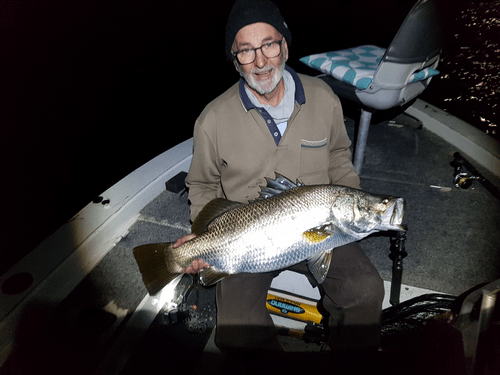
Given that barramundi are more active at night and times of low light it’s clear that if you want to increase your catch rate of barramundi that, all other factors remaining the same, that you should target barramundi at night and other times of low light.
 |
 |
I have not been able to find anything on the evolution of barramundi to explain that in scientific terms but it’s likely that their eyes evolved to allow them to hunt in periods of little or low light for one or both of two reasons. The first is to be safer from predators of that evolutionary time period and the second was that it allowed them to hunt at a more productive time.
So it’s in the barramundi DNA to be more active at night and times of low light such as around dusk and dawn and of course when cloud cover shades their habitat making them less obvious to both their pay and of course their predators. Other than man barramundi no longer have significant predators in fresh water habitats. They may have in the past but evolution has been kind to them in that regard. But in salt-water they are not at the top of the food chain in which they exist … that is the realm of crocodiles and sharks.
WIND / ACTIVE WATER/ SAFETY
Wind creates not only active water in the form of waves on the surface but also currents below the surface and both of them have an effect on where baitfish have been from and too as well the effect on water temperature.
To help understand “where and why barra will be at a given place and at a time” you will need to understand the influence of water movement in creating activated aka energized water.
Bait fish definitely follow the movement of the water and Barra definitely follow the movement of baitfish. If you want to catch fish you have to understand where the fish will be moving from and to so that you can position yourself where you can target them.
As waves and currents are created they also have an effect on water temperature. Barramundi look for aggregations of baitfish and in warmer months when water temperatures are in a comfortable range of around 28 degrees for both baitfish and barramundi it’s water movement, not water temperature, that dominates the movements of baitfish and consequently the movement of barramundi.
Either side of that comfortable range of around 28 degrees water temperature shares the lime light with water movement for barramundi and targeting areas where the water temperature is closer to 28 degrees becomes increasingly important.
And then, as water temperature become too hot in the peak of summer or too cool in or around winter too be comfortable for barramundi water temperature not water movement becomes their dominating driving force.
So, given the above it’s important to keep a close eye on the wind direction and speed for the 3 days immediately proceeding your planned outing. If the direction in particular is consistent in that period that will have a big effect on which points and bays are more likely to hold the bait fish that Barra feed on and therefore where the Barra are more likely to be when other bite windows occur.
From a safety perspective the direction and speed of the wind your expecting is important also. That is because the only concrete launching ramp at Lake Awoonga is located on the NE shore about a kilometer NW of the dam wall.
I’ll fish in almost any weather in a fishing competition that the competition organizers deem fit because I know that there will be plenty of people at the ramp to help launching and recovering boats.
When I am fishing by myself I only fish Awoonga when the wind is coming from somewhere between NNW and NNE. When the wind coming from between those directions the ramp is somewhat protected by the hill to the NE of the ramp and this ensures that waves are not crashing onto the ramp making it hrd and dangerous recovering your boat.
Where ever your going fishing have a think about the logistics of boat management and of course personal safety. With this in mind Safety- wind speed and direction are certainly important considerations when working out where to fish.
DEALING WITH THE WHERE
Whilst the information used to determine where to fish gives you an “educated guess” as to where the Barra will be the circumstances when you hit the water may not be exactly what you expected (and that is so often the case). By working through the following 4 criteria you may be able to get a more current understanding of where the fish are and also the safety implications.
Lining up the “triggers” below, all other factors remaining the same, will help you determine the not so good, better and best locations on the day to target barramundi in Lake Awoonga and other similar barramundi fisheries.
WATER TEMPERATURE DIFFERENTIALS
CLOUD COVER
WIND AND WIND CURRENTS
SAFETY – WIND SPEED & DIRECTION
WATER TEMPERATURE DIFFERENTIAL
Water temperature influences barramundi metabolic rate. As warmer temperatures flattens out into a temperature range which is comfortable for both baitfish and barramundi alike barramundi feed more actively. As water temperatures move out of that comfortable zone the metabolism for both baitfish and barramundi progressively declines and both gradually move more from feeding heavily in bite windows to just snacking as in normal winters or in extreme circumstance struggling to survive.
While preferred temperatures for barra vary location to location, the range from about 26-30°C is the temperature range that is comfortable for both barra and baitfish with the barra preferred temperature being closer to 28°C.
Warmer water times
Once summer settles in the water temperature throughout Awoonga dam and other similar barra impoundments flattens out into a temperature range which is comfortable for both baitfish and barramundi alike. For both, their metabolism increases requiring more food and consequently what moves or concentrates populations of baitfish becomes the dominant force determining where baitfish and consequently barra will be.
Bait-fish, and in particular bony bream, spend a lot more time spread out feeding in the deeper water gently moving around the lake in water currents created mostly by wind. As those water currents approach the shore the shore topography and structure concentrates the currents and moves the baitfish into concentrations that are targeted by barramundi.
To understand where those concentrations of baitfish and therefore barra are you need to consider the prevailing wind direction over the few days before a fishing trip rather than just the wind direction at the time. If it’s been blowing from one direction for a week that will be the dominating force on the movement of water where the baitfish will be and where the barra will be.
In warmer water times when not feeding barra prefer deeper water but when there is a bite window, almost in unison, they follow those prevailing winds and baitfish past those points, eventually finishing up deeper into the bays and often in the murky water toward the back of the bay and then as the bite window comes to an end barra follow the currents back out of the area. The fact that that process takes time may explain why the after dark bite window can be quite short or prevailing right up till after midnight when all of a sudden, the bite window just turns off.
Wind definitely creates a “a moving feast” for barra so it’s important to be aware wind direction and speed predictions so you can position yourself to fish both the early movement of water during a fishing session but also the changing direction of water as a predicted wind direction or as the wind speed change kicks in. So if the wind direction prediction signifies a change to the left then you may choose the LH point rather than the right hand point so that your in the right position to take advantage of barra following baitfish into and out for the bay whereas if you chose the right hand bank you may only be in the right position to take advantage of barra following baitfish into the bay.
From fishing point of view the most targetable collection of baitfish and therefore barra is the points in the main basin of the lake where the currents are either split as they hit relatively squarely onto points or hit onto one side or the other of points and along shores and around corners before dissipating again.
So, for Awoonga and other similar barramundi impoundment when water temperatures are in a comfortable range for both baitfish and barramundi alike the first place you should consider fishing, is the points, and other structure as described below, on the side of the main basin where stronger winds are blowing. That’s where the baitfish are being forced onto those points, along the edges of the points and into the back of bays making them vulnerable. Generally the part of the points that you can see is only the ‘tip of the iceberg’ and you can expect that there will be a gradual continuation of the point below the water forcing baitfish into shallower water and making them more vulnerable, at least until that cut a break and find a friendly current past a weed bank, the shore or some other structure out of the danger zone or into the back of a bay with dense weed banks to hide in or where the wave action has muddied up the water providing some cover.
Barramundi have an inbred natural understanding that these structures around wind swept points is where they are most likely to get a feed.
Keep in mind that if you’re going to fish any of these windy areas you’re going to need a good anchor or drogue or as a minimum electronic anchoring on your electric motor.
Cooler water times
As water temperature start to decline and the water temperatures in different parts of the lake moves further apart the metabolism for both baitfish and barramundi progressively declines and both gradually move more from feeding heavily in bite windows to just snacking. Both baitfish and barramundi become more uncomfortable in cooler water and barramundi in particular become actively preoccupied seeking out warmer water.
In these cooler water times when not feeding barra prefer warmer water but when there is a bite window, almost in unison, they become relatively active and generally without leaving the comfort of the warm areas hey feed or snack.
The windswept points and associated structure will become less of an option but as baitfish will still be in those currents hitting points think about those secondary areas where baitfish looked for a break when the water was warmer such as the back of bays with dense weed banks to hide in or where the wave action has muddied up the water providing some cover from snacking barramundi.
In those cooler times the warmer water is generally in areas where weed banks inhibit the movement of water or shallow bays where warmer surface water has been blown in and it’s common to find barra with their heads poked into banks of weed or just cruising the gutters in the weed banks taking advantage of the warmer water trapped there.
With other conditions remaining the same, as the coastal winds abate at night the water that has been pushed up into bays will start to return to where it came from and that will change the water direction … that will be the direction warmer surface water is moving so look for bays that are in the direction the prevailing winds are blowing and particularly those with points off to either side.
There is a point of course where the effect of gravity or a change in wind direct, no matter how slight, will be stronger than the prevailing wind and that will change the movement of the water either taking the water back along passage ways in the topography and structure and through weed banks from where it came if it’s just a decline in wind speed or if it’s a change in wind direction through different passage ways in the topography and structure of the lake and channels through weed banks and to slightly different locations from where it was earlier in the day and just before the wind change.
Keep in mind that the bite windows are still there but remember that the metabolism of barramundi has slowed so they wont feed as actively as in summer.
BAROMETRIC PRESSURE
My understanding is that barramundi like most scrounger type fish like a relatively stable barometric pressure and if BP is unstable they tend to sulk and reduce their feeding activity. With that in mind you can use BP as a predictive tool to and a explanation tool.
So as a prediction tool, if your going fishing tomorrow have a look at today’s BP. If it’s relatively stable i.e. it hasn’t moved more than a point or two for today and tomorrow’s general weather forecast is basically the same as what was forecast for today that bodes well for your trip tomorrow. If however today’s BP was all over the place or tomorrow’s weather forecast predicts weather changers tomorrow then you can ex-pert tomorrow’s BP to change i.e. it won’t be stable and scrounger fish may be sulking and feeding less.
As an explanation tool during or after each outing it’s worth reviewing the BP during your outing time. IF its been stable that may help explain your success but if it’s been all over the place then that may help ex-plain your poor fishing outcome.
A bit more detail, there is plenty of empirical evidence that the fish, including barra, that are most effected by changes in BP are those that have relatively large air bladders. I haven’t been able to find anything on barramundi physiology that confirms that barra are amongst those fish that have relatively large air bladders but I assume they do. That assumption is based on:
- I can recall reading in the past that barra have relatively large air bladders (aka swim bladder) and that the barramundi air bladder is fairly big and is prized as a delicacy in several aboriginal recipes.
For fish with relatively large air bladders I understand that as BP falls there is less pressure on their air bladder causing the air bladder to expand which puts pressure on other organs making the fish uncomfortable. In response to that discomfort fish with larger air bladders stop feeding and seek out deeper water where the weight of water above them, or a increase in BP, gradually reduces the size of the swim bladder to where they are comfortable again.
Given that I am not surprised that there is significant anecdotal evidence that barra don’t change their feeding habit much at times of relatively stable and high BP but in those periods of above average summer temperatures one can expect that barramundi can sense that the barometric pressure is about to drop as a storm forms barramundi respond in much the same way as mangrove jack to changes in BP which includes.
-
- Other things being equal that triggers a bite window for barramundi can be they feed up pre storm.
Once the anticipated barometric pressure does drop and storm becomes active the barramundi turns off just as quickly as they started feeding.
Keep in mind the safety implications of a change of wind direction … if the wind moves away from being from somewhere between NNW and NNE the wind may be blowing onto the ramp makking recovery of your boat difficult.
If it’s wind speed that changes keep in mind that waves in Awoonga can blow up to around a meter making navigation difficult.
CLOUD COVER
In daylight hours, when cloud cover has been fairly stable for a few days prior to you outing and during the outing as long as other weather conditions and trigger events are present fishing for Barra can still be good.
After dark and particularly when evening and or night fishing for Barr at the time of the new moon cloud cover seem to turn Barra off.
STEALTH
Keep in mind that barra are easily spooked so you have to be stealthy in your movements and casts.
-
- When you approach an area you going to fish do it slowly and if available quietly under the power of your electric motor and take advantage of any cover that’s available. Don’t cast a long shadow over or motor over over the water your going to fish.
- Longer casts are important. You will increase your results exponentially if you can consistently achieve long accurate and tidy casts of both fly and lure. Particularly when fly fishing, make sure long and tidy casts. The same goes for lure casting. Even if your targeting a close by barra it’s a good idea is to cast beyond the fish so as not to spook it and to ensure that your lure is swimming at the right depth and speed as it approaches or passes the target. It’s not that your line or the casting itself is spooking barra it’s just that barra are spooky and will hear the boat if its too close to where your fishing and also that barra do like to follow an offering and will turn away if they sense you are close.
- Whilst on casting, another thing to remembers is avoid casting right at a fish. The best option is to cast either side and beyond the target with a preference of casting on the side to which the barra is moving. Barra will generally hear a fly or lure land and if you haven’t spooked them they will often turn to the side the impact came from so as to investigate. Then if your fly or lure casually swims past them your in with a chance.
- Also where possible get the sun off to the side or in your face as that will help mitigate barra seeing the flash, particularly of a fly line, as it’s cast.
- How you set your boat up to target barra is important because particularly at night or leading up to or in a bite window you don’t want to be moving around.
- So, after considering all of the above and favoring a spot with some surface movement as opposed to a calmed-out position and picking your spot it seems that the best approach is to spot lock (anchor up) with room to put your best casts in behind and to the port and starboard of the boat. If there is weed target casting just in front of the weed and then retrieving the fly or lure down the face of the weed.Whilst on the topic of anchoring up remember that tying up to a tree is a great alternative to spot locking your electric motor or deploying an anchor. In any case you have to do that with stealth so take care not to bump the tree with the boat … barra will hear that from a long way off. If your tying up to a tree make sure that tree and others do not interfere with your casting or landing fish … you catch very few barra with your fly or lure firmly snagged half way up a tree or in the case of landing fish with your leader or backing wrapped around a tree trunk. Checking what your doing on your sounder is a good idea but if you have the basics above right it should not dominate your decision making. If you have set up correctly you can cover a channel or passageway through topography or weed banks, or the edges or back of a bay and either side of the boat. If you’re fishing soft plastic or hard bodied lures that’s comfortably two hundred feet around the boat but with fly fishing that area reduces by at least half.
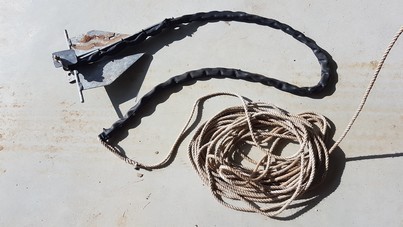
- I generally spot lock the electric motor these days but still carry a sand anchor (aka fluke anchor) just in case my spot lock is not working. In that case my rode is made up of 2.4 meters of chain that is connected to the crown of the anchor with a shackle. I have then covered the whole chain all the way down to the shackle with an old push bike inner tube. The bike inner tube mitigates some of the noise of the chain as it’s being moved into position around the boat before deploying the anchor and then when you deploy the anchor. I have then laid the inner tube covered covered chain along the side of the anchor shank and then connected the inner tube covered chain to the hole in the top of the anchor shank with a couple of cable ties. It pays to carry a few spare cable ties in the boat tool kit just in case you need to repair your anchor rode. Connected to the top of end of the anchor chain I have 100 feet of 10mm “silver” rope. If the anchor gets snagged, for example under a drowned tree or under the edge of a rock, I can move forward into the wind and then put pressure on the anchor rope to break the cable ties to pull the anchor out from under the snag with the chain connected only to the crown of the anchor. By the way this is not an alternative for your normal anchoring system … I also use my 5.3 meter Polycraft boat off shore and for offshore safety reasons I have a big reef anchor with 5 meters of chain and 200 meters of heavier “silver” rope.)
 |
FLIES AND LURE SELECTIONS
ADDITIONAL NOTES
- Barra do seem to prefer areas around standing timber in the morning and areas of weed banks in the afternoon.
- Fish for only 30 minutes without a fish and then change something
- Position
- Lure, softies, flies
- Target depth
- It’s worth noting that particularly after dark there are often as many fish along blank shores that have no trees or visible weed banks.
- Never forget that you need to focus on fishing at the depth that barra are holding or hunting in. So in low light you many need to fish deeper than at times of good light. You can substitute ‘moon light’ for “light” at night time.
- My 80:20 rule is to fish slow 80% of the time and faster for 20% of the time or until you find out what’s working at that moment.
- Work through your retrieves until you find out what’s working at that moment.For example:
- Slow roll with or without pauses
- Draw with pauses of various lengths
- Roly poly or fast winding at a range of speeds with or without pauses for flies and lures
- For flies strip at various speeds with pauses or without pauses or for lures jerk bait retrieves at various speeds. Those retrieves can be very fast or almost static but in each case plenty of jerky actions provided by rod movements.
- Jumping across the bottom
- Surface retrieves that depend on the type of lure or fly
== I have fished the Boyne pretty much through all seasons and understand why it is regarded as one of the iconic fishing locations for the Gladstone Region. It can produces Barramundi all year round even though the number caught is often low. Other target species include Mangrove Jack, Grunter,...
Last Updated: May 2026== Gladstone is blessed with a lot of fishing options including iconic rivers such as the Boyne and Calliope rivers, Awoonga dam which is famous for its barra and of course expansive estuary waters including a 40 kilometer stretch of water between Curtis Island the Main land called The Narrows. On...
Last Updated: May 2026== The Narrows is a 40 or so kilometre stretch of water that runs between the mainland and Curtis island. For me the southern end of the Narrows as far north of the Crossing just below Ramsay Crossing is the gem of the estuary fishing in Gladstone. The reason I focus on that area is that it...
Last Updated: May 2026== Even though South Trees Inlet is connected to the Boyne River it is a separate water course in its own right. Historically it was an inlet with a problematic braid linking it to the Boyne River but the transfer of water from the Boyne River to the inlet was very light. Between 2002 and 2005...
Last Updated: May 2026==Awoonga Dam was created by damming the Boyne Rive with a rock fill structure faced on the lake side with a concrete skirt to mitigate erosion in the case of overflows. The 650 odd meters of embankment is 540 meters high at its highest point and was built from rock excavated from a quarry on the...
Last Updated: May 2026One of the things I still enjoy about fly fishing is tying a fly and then catching a fish on that fly ... it's a fantastic sense of achievement. Unfortunately fly fishing options around where I live in Central Queensland are limited by strong prevailing winds and strong tidal flows so more often...
Last Updated: May 2026A fly line is a fundamental piece of specialized equipment for the fly fisher. Modern fly lines are made from special polymer materials which are extruded around a core generally of monofiliment or more recently braid. The key difference of the two core materials to the fly fisherman are the...
Last Updated: March 2026Over time I have come to understand that there are two distinct classes of Barramundi in Lake Awoonga and other similar freshwater impoundments ... "residents" and "travelers". Residents Barra are released into Lake Awoonga generally at a range of sizes from fingerlings to grown on fish of around...
Last Updated: March 2026The Jackall Transam 95mm weighs 20g and is the first vibe that I caught barra on in Central Queensland and it is still my favorite. It sinks quickly and has a really tight vibration at a range of speeds. Effective across a wide range of retrieves from vertically vibing through schools of fish or...
Last Updated: March 2026Yakamito Hyper Jerk 90 jerk minnow - sardine
Last Updated: March 2026The Zerek Live Mullet is a jointed soft plastic swimbait that is built from the super strong TPE. They swim well reaching depths of around 2 meters on a slow roll and of course swim a little shallower on faster retrieves. They are available in 3.5", 4.5" and 5.5" sizes and in 13 colours. Like all...
Last Updated: March 2026This walk the dog type lure is an older model and the colours the orange chrome is no longer available. I was lucky to snag a couple of these at our local Tackle World. The new ones have a lateral tail fin that stabilizes the retrieve a little but I am happy without that because without the tail...
Last Updated: March 2026This just one of the Happy Rock softies that is a credit to its designer Trev Burgess. He gave me my fist one probably two years ago and I have been using them ever since. Unfortunately Trevor passed away in a tragic boating accident at Lake Awoonga on 4th September 2020. A very sad day for our...
Last Updated: March 2026"Plastec" is the name given by ZMan for their proprietary form of TPE material. It's different to the TPE material used in Zerek, Chasebait, Transams & Barumbah lures but still has to be stored away from traditional plastasol soft plastics. I store each of my straight TPE and Zerek TPE soft...
Last Updated: March 2026The Jerky J Swimbait 7" is one of just a handful of soft plastics I rely on when Barramundi fishing in competitions. Predominately this is a dusk, dawn or full moonlight soft plastic. My three favorite colours are: Green Shad as in the top of the photo above Boneless Chicken which is a translucent...
Last Updated: March 2026Slickrigs are one of the most successful soft plastics that "Squidgies" ever produced. In the 130mm size they come in packs of 4 lures fully rigged ready to fish ... on that basis alone have been a popular barra lure for a number of years. When I started to get involved in competition barra fishing...
Last Updated: March 2026Powerbait hollow belly soft plastics are available in 5" and 6" versions and I use them for both weedless and jig hook presentations. The four colours that I use are: Tennessee shad Hitch Bone shad Blue gill Weedless hook presentations In those cases The reason for that is that they are indeed...
Last Updated: March 2026Bombers in general are a very well known lure and it's likely that one or more colours are represented in lure boxes across Australia than any other lure. They have a retrieve depth of 2-3 feet when cast but on a longer troll swim down to 4-8 feet even at a slow speed. Bomber BMB Long The brown...
Last Updated: March 2026The Jerky J Swimbait 5" is the little brother of the &' version. It's a great lure to employ at those times when barra are looking for smaller baits or when smaller baits that land softly are required. My three favorite colours are: Salt and pepper as in the top of the photo above Golden shiner...
Last Updated: March 2026There are very few fish that don’t eat prawns or at least shrimp. Prawns can be fished in a number of ways right through from horizontal rolls at various speeds and depths to long vertical or angled lifts and falls in the zone where fish are holding or even jumped back to the boat just above the...
Last Updated: March 2026This jointed soft plastic swim bait is ready to use straight out of the packaging and is a favorite of mine for deeper water. The form and a very fish like swimming action of this paddle tail are complemented by a small spinner under the the belly which adds just enough flash to bring it to the...
Last Updated: March 2026Whilst the Zerek Ripper Diver was designed with trolling in mind, the Ripper Diver incorporates a weight transfer system that enhances its casting distance. It's a floating lure which is handy when fishing around snags and on the cast swims at around 3 meters. The side to side wobbling produces...
Last Updated: March 2026This is a lure I have added to my Coastal and estuary lure box particularly for barred grunter. Grunter turn up in our estuaries and rivers during summer and will often stay there until heavy rain makes it too dirty for their liking. In times of low rain they may stay in their summer abode right...
Last Updated: March 2026Like the Belister Juggernaut this lure has unique properties that have earned it a place in my hard body lure boxes. It's not a an every day lure for me and only comes out to play when fishing for barra I can see in deeper water when I have my Garmin's set in "Perspective" mode. Being relatively...
Last Updated: March 2026This is one of the bigger soft plastics that I carry and is only pipped for size by my 8" top pour soft plastics. Both these big lures generally get a swim any time I am fishing in low light or in dirty water. This is the biggest of the DieZel Minnows that I use and I like it because the Z Man...
Last Updated: March 2026This is my favorite medium size soft plastic paddle tail swim bait and has a great mullet shaped profile and realistic swimming action at any speed. I rig it in two ways. On TT Headlock jig heads generally in 1/4 oz and 3/8 oz sizes It has a big advantage over most other paddle tails rigged on jig...
Last Updated: March 2026This is a fantastic lure from my point of view and and one that carry in all sizes except 165mm. The three sizes I carry are 65mm, 95mm an 10mm. All 4 sizes come in an extensive range of colours. Even when the lure is sitting on the bottom, the slightest current will have the tail pulsating and...
Last Updated: March 2026I am pretty sure that barramundi take these long thin soft plastics as garfish which are a popular food source for Barramundi. The Alpha Gar is based on my Hammer Variant with the main difference being it is much thinner. Like my Hammer Variant as well as a very active tail the Alpha Gar have a...
Last Updated: March 2026FIRST PUBLISHED:(3 October 2022) This is a hybrid of two very different types of lures ... a prawn imitation and a grub tail soft plastic. Both those types of lures have their place but I have to say that this combination, my grub tail prawn, has earned a place in my tackle box as a...
Last Updated: March 2026The Westin "Bony the Bream Vibe is 100mm and 30g of weight and is one of my favourite Vibes particularly in stripy perch (black/orange) & smelt (which is basically white with a little orange). If barramundi, fingermark, mangrove jack, make up any of your fishing tastes then you have a new best...
Last Updated: March 2026The Belista Juggernaut is unique in that it has a built in flashing light at the tail that comes on when the lure gets wet. I over-paint my Juggernaut's in two popular barra colours. The first is gold with black bars and the second is black with chartreuse bars. In each case the area where the...
Last Updated: March 2026With a diving depth of 8 feet on the cast the original Barra Bait has been one of the most popular Barra lures in Australia for many years and is still a great option particularly on the troll. This classic design has been responsible for some of the largest Barra ever caught in Aussie waters!
Last Updated: March 2026The Jackall Super Squirrel 115 lures was released as bigger brother to the Jackall Squirrel 79 in 2020. They are Hank tuned and consequently they come out of the box already tricked up with hardware suitable for barra. The super Squirrel swims at 4 meters and is currently only available in a silent...
Last Updated: March 2026Process: In the example below I am making two 46g two layered soft plastics. So in this case that will take 92g of material. The bottom layer is deeper and will use about 60% of that and the top layer is only about 7mm thick so it will use only the remaining 40 % of material. For each colour I also...
Last Updated: March 2026This colour is called Olive Scale and it has a diving depth of only 1-2 meters. This fills a gap in my hard body lure box for a relatively shallow diving lure in natural colours for use around structure and weed banks and weed bombies.
Last Updated: March 2026The 25A features the trademark Bomber tight wiggle and rolling movement that creates a life-like swimming action. This is a deep swimming lure and swims at 12-15 feet on the cast and 20-25 feet on the troll. Deep Long A Lures produce the same seductive action whether fished with a slow retrieve or...
Last Updated: March 2026One of my favourite past times is dusk and night fishing for big barramundi in Lake Awoonga. To be successful in the dark it's important to have the right gear at hand and knowing where each item is. My Lake Barra check list helps in that regard ... there is a place for everything and everything is...
Last Updated: March 2026Although mainly trolled, the Scorpion 150 is a great casting lure for big salt and fresh water barra. On the cast it swims down to 3 meters. The “butterknife” tail aid in easy casting and the lure quickly descends to around 3 meters. When trolling areas of structure, the buoyancy of the lure and...
Last Updated: March 2026Quicklinks Plastisol is a high quality liquid soft plastic that is Phthalate free and is the common base material for most soft plastic lures. Lures made of this material should not be stored with lures based on Elastec material such as Zman lures or lures made of TPE materials such...
Last Updated: March 2026Quicklinks Plastisol is a high quality liquid soft plastic that is Phthalate free and is the common base material for most soft plastic lures. Lures made of this material should not be stored with lures based on Elastec material such as Zman lures or lures made of TPE materials such...
Last Updated: March 2026As fresh and salt water lure that on the cast has swim depth of 10+ feet and on the troll it swims a little deeper. The Classic 120 Barra has an unmatched tournament-winning heritage and for many years was the first choice of all serious Barramundi anglers. It has slipped from that position these...
Last Updated: March 2026This is the deepest swimming lure that I carry and on the cast can swim at a depth of 20 feet. The River Rat is a stand-out general purpose saltwater lure, that is great for both casting & trolling. I carry just one colour and that is the Bobby dazzler gold.
Last Updated: March 2026The Pointer 100XD is an extra-deep diving jerkbait. It has a reputation of swimming straight from the moment you take it out of the pack. Off the cast it has a swim depth of 10 feet. I often use this lure when the water is colder and barra are sulking in deeper water. Gunmetal shad - a very flashy...
Last Updated: March 2026On 29th September I was fortunate to be invited by Scott McAuley, who I have fished with socially on quite a few occasions, to partner up with him to fish the 2020 Venom - Lake Awoonga Open. The competition was made up of three sessions, one on each of Tues 29th Sep, day two on 30th September and...
Last Updated: March 2026We are very lucky in Central Queensland (AKA "CQ) to have an extensive range of big fish that we can target. That includes but is not limited to the species listed below. Barramundi (both freshwater & saltwater) Kingfish (Yellowtail and Cobia) Lutjanids (Mangrove Jack & Fingermark) Javelin fish...
Last Updated: May 2024This post is a work in progress and lists the different species of fish I have landed on fly in Central Queensland. I have had a look through my photos from the last couple of years and added those that I have found but there are still some photo gaps which I'll add as I find the photos or will...
Last Updated: May 2024The Zerek Fish Trap lipless crankbait has a unique design that integrates the action of a vibe with the versatility of a soft plastic as well as a grub tail adds another vibrating hot spot to the lure both when being retrieved and even in response to the smallest movement when on the pause. Made...
Last Updated: April 2023Jackall Squirrel lures are all Hank tuned and consequently they come out of the box already tricked up with hardware suitable for barra. The original 79mm version swim off the cast at around 3 meters and a little deeper on the troll and come in a version including rattles and a silent version. In...
Last Updated: July 2022Quicklinks There are times when the right bait for barra is a hard bodied lure. Selecting the right style and swimming depth of hard bodied lure is definatley one of the keys to that process. You can do things with hard bodied lures that you can’t do with any of the soft plastics...
Last Updated: July 2022These are expensive lures at about $40 a pop but there are times when thay can be gamchangers so it would be a sham not to have one or two in you kit. The Barambah Bony Shad Lure has interchangeable weights that allow anglers to set the depth. The slow to medium sinking shad can be fished from 1...
Last Updated: July 2022Historically, weedless soft plastic paddle tails have had a poor reputation for hook up rate because the soft plastic material does not compress enough when a barra takes the bait. This ingenious soft plastic paddle tail has all the fish attracting capabilities of other soft plastic paddle tails...
Last Updated: July 2022The SugaPen 120mm is a uniquely designed dog walker. This lure is designed to splash with it cupped face, like a popper, but have the advantages of being a dog walker which attracts more fish. The colour I have selected is GT287 which is silver with a little bit of orange under the chin. This is...
Last Updated: July 2022This is one of those lures that has stood the test of time. Originally designed as a barra lure for Northern Territory fisheries the B52 had evolved into a popular Australia lure for not only barra but for many other fresh and saltwater species. This lure swims at around 1.5 meters and fills a gap...
Last Updated: July 2022This is a silent running suspending lure that dives to the depth of 3M+ and one of my favorite lures for prospecting around weed beds and other structure. Samaki REDIC are crafted of the highest quality materials, ABS body is the best in its class, offering unmatched strength and crisp clear bib to...
Last Updated: July 2022The L120 swims at around 2.5M on the cast and just a little lower than that on the troll. The cast has a straight tradectory because the weights move to the rear of the lure and then as the retrieve starts the weights lock in place back towards the front of the lure enhancing the swimming action of...
Last Updated: July 2022Quicklinks My #10 weight fly box for temperate & tropical destinations »
Last Updated: October 2020