






Emergers
As the pupa or sub-imago of Mayflies, Caddis, Midges, Stoneflies, Dobson flies etc. move to and through the surface of the water to hatch they are referred to as emergers and when large numbers go through this process at the same time it is referred to as a hatch. When fish are feeding on emergers it is important to be fast and accurate in your casting and to match the form and function of the natural. When the naturals are large enough in individual size one very successful technique is to fish an emerger pattern on top as both a fly and an indicator and a nymph or midge pupa suspended just below it. Hits are often on the dead drift or on the lift.
If flies fall into just two basic groups, wets and dries then emergers have to be regarded as dries even though the are typically fished in the surface film.
Have a look at a full list of emergers featured on this web site: QUICK LINK
From the above list I choose to carry just these few:
Possum emerger |
 |
Shuttle cock brush |
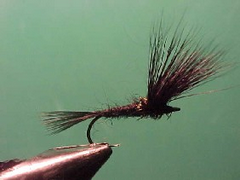 |
Charcoal Hares ear Olive Brown |
Klinkhammer |
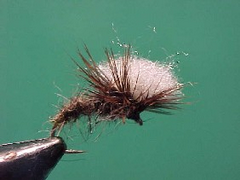 |
Charcoal Olive |
Para dun emerger |
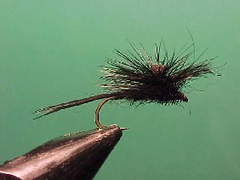 |
Black Turkey brown Olive Adams |
Trailing shuck caddis |
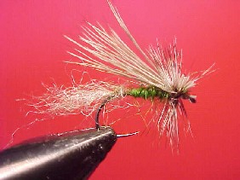 |
Cream Lime Black |
Midge ball |
 |
Natural |
Shipman’s buzzer |
 |
The name of this fly is Welsh and literally means "little devil". Regarded by many as one of the best flies ever created this fly is a great tie on as trout take it for everything from midge pupa right through to nymphs and stick caddis. I normally fish smaller sizes as a midge pupa and from time...
Last Updated: April 2026This combination of my Bibio variant and Peter Walsh's tiger midge. Fish it in the same way as you would fish a bibio ... often it will come up trumps. Materials Hook Thread Weight Ribbing Body Thorax Hackle Knaped grub hook in size #14 Black Just the ribbing wire 6 wraps of medium 10 gr #30...
Last Updated: April 2026When Chironomids are around they tend to be around in large numbers and trout become quickly switched on and gorge on them. There are number of techniques to target chironomid feeders and one of my favourite is to fish three chironomid imitations with the heaviest on the point with a long leader on...
Last Updated: April 2026This fly hangs from the surface with the bend of the hook down much in the same way as the natural hangs just as it is breaking the water surface - anyway that's my story and I'm sticking to it. In any case it is a suggestive fly that has taken many fish during evening midge hatches. Try it in...
Last Updated: April 2026What does it take to make a nymph float? There are really two simple elements behind the science that explains why things float or appear to float. The first part of the science is pretty simple and is down to Archimedes who worked out that for something to float it had to displace at least its own...
Last Updated: April 2026This is very popular Northern hemisphere fly and whist it more popular in still water it also has its uses in running water. Appealing to fish that are on mixed diet that includes mayfly nymph and midge. Materials Hook Thread Tai and body Ribbing Thorax Wing casing Breathers 10 to 14 nymph...
Last Updated: April 2026This fly is designed to be fished on the drop and then on the rise. It was originally designed to imitate the action of lake Jindabyne olive midges as they hatched but it has proven useful in other fisheries. Materials Hook Body Thread Wing casing legs Thorax 10 to 14 dry fly hook Olive cotton...
Last Updated: April 2026This fly is also often referred to as an "Elk Hair Emerger". When a caddis fly hatches it rises to the surface of the water, shedding its nest and shuck as it breaks through the surface tension of the water so as to reveal its wings. Caddis flies often use surface movement caused by wind and...
Last Updated: April 2026This is more of a class of flies rather than just a fly. Perhaps the best known Para Dun Emerger is the Parachute Adams. It was derived form the Adams Irresistible and whilst the Irresistible sits high on the surface film the parachute version sits comfortably in the film making it a very useful...
Last Updated: April 2026This Dutch fly designed for Grayling but is equally at home with trout and regarded as many amongst the best emerger patterns ever tied. It's well suited when fishing to emerging mayflies and caddis feeders and is easily seen on the water because of the poly yarn post. Whilst you can tie these in...
Last Updated: April 2026Emergers which resemble a shaving brush became popular a couple of years ago and continue to get support in the fishing press. They are tied to represent a nymph that is trapped in the surface film just at that point of time when it is opening its wings. They are best fished, as a covering fly, to...
Last Updated: April 2026When a caddis fly hatches it rises to the surface of the water, shedding its nest and shuck as it breaks through the surface tension of the water so as to reveal its wings. Caddis flies often use surface movement caused by wind and currents to assist in this process. Fortunately they break through...
Last Updated: April 2026The family Chironomidae are part of the “True Fly” or Diptera order and included non-biting Midges such as those that sometimes swarm around you like small mosquitoes but don't bite. The general form of the pupa has 9 segments a thin body and is typically up to 10 mm in length. When midges are...
Last Updated: April 2026Shipman's buzzer was tied as a surface fly for Rutlands Reservoir in England. A great buggy looking buzzer that applications anywhere buzzers are emerging. Materials Hook Thread Siphons and trailing shuck Rib Body & thorax Knapek dry #10 to #14 To suit body White antron dubbing Holographic...
Last Updated: April 2026Peter Hayes would be one of the countries top fishing guides, his level of professionalism and innovation in the industry is well known, as well as being a former Australian fly fishing champion. Nine times Australian casting champion only adds to the list of impressive credentials. Peter fished as...
Last Updated: April 2026This is just the simplest imitation of a snow flake caddis laying on the surface of the water. The shape and size are right for any of the small caddis and and it floats well. Materials Hook Thread Body Knapek wet fly hook (the dry fly hook is too flimsy) Gray Clipped light natural deer hair (you...
Last Updated: April 2026The gray duster was one of the first flies I tied. It was at a fly tying course at Illawarra Fly Fishers in Wollongong and this fly was selected because of its simplicity and of course the fact that it works. Over time my tie of a gray duster has been corrupted to be a sort of melding of the gray...
Last Updated: April 2026The authors of “The Fly Tiers Bench-side Reference” previewed this new concept in emerger flies in the Fall 2002 issue of Fly-fishing & Tying Journal. You can apply this technique to almost any of your favourite nymphs as long as you remember to substitute light materials for any materials in...
Last Updated: April 2026Bibios and bibio variants are amongst my favourite ten flies. This royal bibio version is always worth a swim, particularly if there are midge or damsels around. It's a variation of the original bibio except that the dubbed body has been replaced with the same sort of body you find on royal wulffs...
Last Updated: April 2026Perhaps the best known Para Dun Emerger is the Parachute Adams. It was derived form the Adams Irresistible and whilst the Irresistible sits high on the surface film the parachute version sits comfortably in the film making it a very useful emerger pattern. Available on line – just $2 each fly tied...
Last Updated: April 2026