






Offshore / Pelagic
Offshore environments feel defined by scale.
Once the coastline falls away, structure becomes less visible, and the sense of reference begins to fade. The water deepens quickly, colour shifts to a uniform blue, and the horizon stretches without interruption. It can appear featureless at first — vast, open, and without clear direction.
But beneath that surface, the system is anything but empty.
Life offshore is organised around movement rather than fixed structure. Currents travel long distances, carrying temperature, nutrients, and bait with them. Where these currents meet, diverge, or change speed, subtle boundaries form — lines that are often only visible as slight variations in colour or texture on the surface.
These edges are rarely static.
They shift with weather patterns, ocean currents, and seasonal changes, forming and dissolving over time. What held life one day may move kilometres away the next. Understanding offshore environments becomes less about returning to a place, and more about recognising the conditions that create opportunity.
Bait gathers where these conditions align.
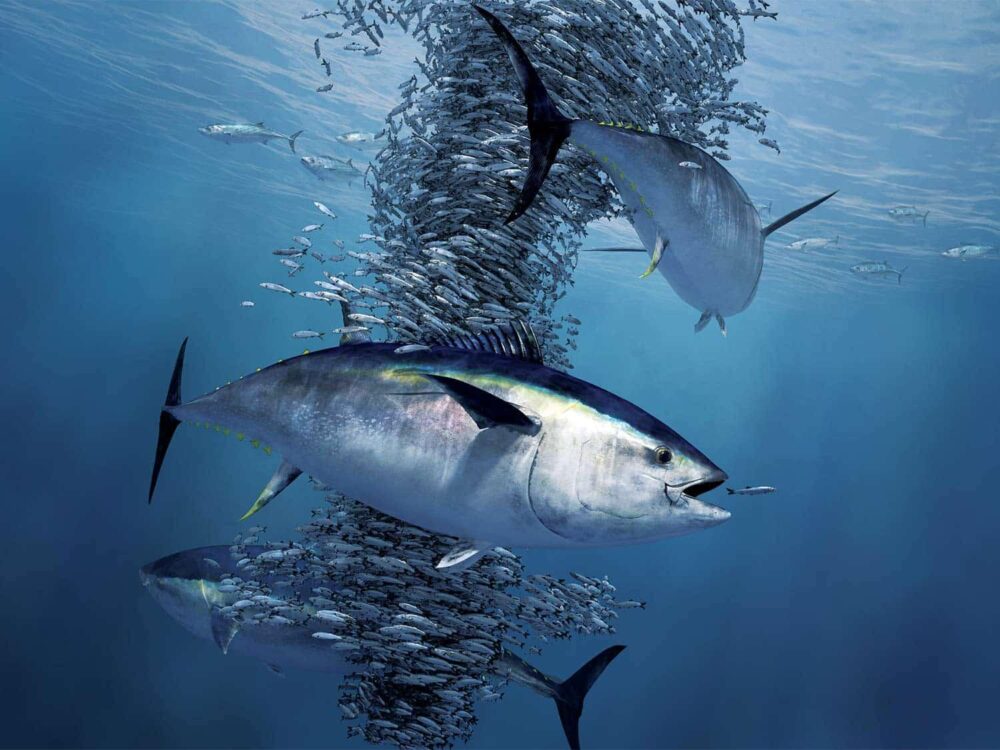
Small fish are drawn to areas where temperature and current bring food within reach. At times they form dense schools, compressed by the surrounding forces. Surface signs begin to appear — birds working overhead, patches of nervous water, occasional flashes beneath the surface.
These are moments when the system reveals itself.
Predators operate across a different scale here.
Rather than holding position, they move with intent through open water, covering distance and responding quickly to changes in their environment. Tuna, mackerel, and other pelagic species use speed and coordination to push bait into tighter formations, often driving it toward the surface.
When this happens, the water becomes briefly concentrated with activity.
These windows can be sudden and short-lived. A calm surface can shift to visible feeding in moments, then return to stillness just as quickly. The pattern repeats, but rarely in the exact same place.
Observation plays a different role offshore.
With little fixed structure to rely on, attention turns to signs — bird behaviour, current lines, floating debris, temperature breaks. Each offers a piece of information, but none tells the full story on its own. Over time, these signals begin to connect, forming a broader understanding of how life moves through open water.
Timing is influenced by larger forces.
Tides still matter, but their effect is often secondary to current strength, water temperature, and the presence of bait. Seasonal patterns can be more pronounced, with certain species appearing and disappearing as conditions shift over months rather than hours.
Patience takes on a different meaning here.
It is not always about waiting in one place, but about staying aware — reading the water, adjusting to what is observed, and recognising when the system begins to align.
There are few environments that feel as expansive.
Offshore waters sit beyond the visible structure of land, shaped by forces that operate across great distances. The scale can seem overwhelming at first, but within it, patterns exist — subtle, shifting, and precise.
It is in recognising those patterns that the environment begins to make sense.